Skip to content

Dr. Darin Davis

Minnesota independent pro wrestler discusses past experiences and the current state of pro wrestling

Archive

Tag: WWE

At the start of each year, I put together a post of what I felt were my best articles for the previous year. A lot of things were going on in the past year, many out of my control, that kept me from motivating myself to share some stories that I had been meaning to share. They also kept me from even watching a lot of wrestling in the last half of the year, and from starting a few other projects that I wanted to get to. I will share them eventually, hopefully in 2012.

—–

Below are the my best articles for the year 2011, listed in chronological order. If you didn’t get a chance to see them when they were first posted, you may want to check these out.

Previous articles are always available through the Archives box on the right, the Category selection, or the Search box.

In a previous post, when I was commenting on liking WWE Tough Enough, I had this to say: “I’m always interested in a program like [Tough Enough] to see how much they reveal about the wrestling business. It turns out not a lot, but enough to hold my interest and give me a little more wiggle room in what I write about on this site (more on that in a later post).” This is the “later post” I was referring to.

When I started wrestling training, I entered into a non-verbal agreement to “protect” the business- meaning to not reveal the inner-workings of the business to anyone that is not part of the club. Friends, family, reporters, etc. (Actually, I can’ t call it a non-verbal agreement since Billy Blaze threatened to break my arm if I ever said anything about it).

For those in the corporate world, you can think of this vow of confidentiality as a Non Disclosure Agreement, or NDA. An NDA is a legal document between two parties that prohibits them from disclosing certain privileged information to another party. They can talk freely between each other without worrying that the information would be revealed to someone else.

However, in an NDA if any of this privileged information becomes publicly known through some other means, then either party can choose to freely talk about it without violating the terms of the agreement.

My take of how this applies to me and pro wrestling is that if some major promotion (WWE, TNA, New Japan, etc.) decides to publicly reveal something about the business, then it is fair game for me to talk about it without feeling that I’m “pulling back the curtain” too much.

So how public is public? Does it have to be on their own programming, web site, or press release, or is it anything that makes it into the public domain, even if it is “leaked”? In my case, the short answer is that “it depends”.

As an example, I rarely if ever make any references to whether the outcomes of the matches are “real” or “predetermined”. It’s probably one of the most asked questions, but I still don’t feel comfortable answering that question in a public forum.

However, Vince McMahon answered this question for me all the way back in 1989 in order to save his company a few bucks. I remember it being national news at the time, and a short account of it can be found in this excerpt of the book Ringside: a history of professional wrestling in America:

Since the establishment of state athletic commissions in the early twentieth century, boxers, wrestlers, and their promoters found themselves required to pay state licensing fees as part of doing business. In 1989, [Vince] McMahon decided that he would move to avoid paying these fees. In a meeting with the New Jersey Athletic Commission, WWF representatives admitted that their matches did not represent legitimate athletic contests because the victors were predetermined. McMahon announced that his product could not be considered a sport, and therefore should not be licensed, because the WWF merely offered “sports entertainment.”

I started professional wrestling in 1997, eight years after this revelation, so you would think that would mean I would be free to talk about it.  But it just doesn’t feel right. It feels like I would somehow be dishonoring the decades of professional wrestlers who came before me and spent their lives making it seem believable.

The right answer for questions like, “Is it real?” is “it doesn’t matter”. Did they make you believe it? If they made you believe it, then the answer to whether it was “real” or not doesn’t matter. To you it was real. If you knew the answer, would it make you enjoy it more? Or would it be a letdown?

I read a blog post from a New York state newspaper the other day where the author said, “…and yes I know that the matches are predetermined 98.3% of the time…“. So here’s a guy that is somewhat of a “smart” fan who knows some amount of information about the inner workings of the wrestling business, and yet even he is convinced that nearly two percent of the wrestling matches he’s seen were not predetermined. Despite what he knows, the wrestlers involved in two percent of the matches were able to convince him that it was real. Why would I tell him that it wasn’t?

Some of the information that fans think they want to know would cause them to be disappointed if they got a definitive  answer. Those thinks I most likely won’t discuss here. For other things that have already been revealed by someone else (e.g. a major wrestling promotion), I will freely talk about it if it helps the message or story I’m trying to tell without worrying too much about what those in the business might think.

Although I still might get my arm broken.

TNA changed their name to IMPACT WRESTLING (all caps) so that they could say the word “wrestling” as much as possible. Then they got a bunch of drunk people to comment on why they like wrestling, so that they could air it at various points in the show. Actually, I don’t know that they serve beer at Universal Studios, but I would think you would at least want the guy to act drunk if he’s portraying a wrasslin‘ fan, right?

This is in direct response to the WWE, who I like to call “The Company Formerly Known as World Wrestling Entertainment” (TCFKAWWE), after they made it clear that they do not want to be referred to as a wrestling company (WWE “No Wrestling” Policy).

Impact Wrestling (sorry, I won’t type all caps) is trying to capitalize on negative feelings from wrestling fans about the recent policies of the WWE. Will this cause people to start watching Impact? They aren’t in head-to-head competition, so I don’t see the ratings improving because of this alone, especially once the new viewers experience the end product. If someone gets fed up with the WWE, will they turn on Impact instead, or just play video games or any other activity you could do during those two hours?

Is TNA/Impact being genuine about their passion for wrestling, or is this just a publicity stunt? While I think the passion for “wrestling” is genuine from the workers, the company still does a lot of stupid crap in the booking department that gives wrestling a bad name.

I can say personally that my interest in watching the national promotions goes in cycles. For a few years I was watching all programs of WWE and TNA (and keeping track of them: TV Match Ratings, TV Viewership Stats). For the last 3 months or so, I’ve watched almost nothing.

The one thing that has held my attention is WWE Tough Enough. I’m not a fan of “reality” TV at all, but I’m always interested in a program like this to see how much they reveal about the wrestling business. It turns out not a lot, but enough to hold my interest and give me a little more wiggle room in what I write about on this site (more on that in a later post).

Impact gets a pat on the back from me for standing up and saying that there’s nothing wrong with having a wrestling company that still calls it wrestling. But if they aren’t going to make good use of the talent they have, I will not be a frequent viewer no matter what they call it.

According to the Bleacher Report, the WWE was upset when an article appeared on a TV industry web site, TVweek.com, with a headline that Drew Carey had been inducted into the WWE wrestling Hall of Fame (I can’t link to it, because it’s been taken down… see below).

The reason the publicist was upset was because the article implied that the WWE was a wrestling company, of all things. That sounds like grounds for libel.

The email  the WWE publicist sent to the site said:

We are no longer a wrestling company but rather a global entertainment company with a movie studio, international licensing deals, publisher of three magazines, consumer good distributor and more.

Let’s see… You have a movie studio. They make some B-grade action movies, some direct to video, starring one of your wrestlers Superstars. Your international licensing deals are for wrestling merchandise (and maybe some of these crappy movies). Your three magazines are about wrestling. Your consumer goods are wrestling merchandise. You add that all up and it makes you “no longer a wrestling company”?

And in a later phone conversation from WWE PR:

TVWeek: Your release says that [Drew] Carey is being recognized as being an entrant in the 2001 Royal Rumble. I believe that was a wrestling event.

WWE PR: No, we don’t do wrestling events. They’re entertainments. And we don’t call them wrestlers. They’re Superstars and Divas.

TVWeek: I really don’t have time for this. WWE presents wrestling events. I’m not going to change the headline or anything in the item. If you’d like, I’ll just remove it.

WWE PR: Huh? What?

TVWeek: I don’t have time for this. What do you want me to do?

WWE PR: Remove it.

I can imagine this conversation happening:

Joe: “Hey Bill, do you want to watch the ‘entertainments’?”

Bill: “The what?!?”

Joe: “The entertainments. The Superstars and Divas.”

Bill: “What are they doing?”

Joe: “They’re… entertaining. They are in an arena, and there is a square ring with 3 sets of ropes”

Bill: “Is it boxing?”

Joe: “No. They’re not boxing. There are punches, but it’s not boxing. They are grabbing each other too, and throwing each other around.”

Bill: “Mixed martial arts? Like UFC?”

Joe: “No, it’s not that. It’s… kind of hard to explain.”

Bill: “Would I know anyone that does it?”

Joe: “John Cena, Randy Orton, CM Punk. Stone Cold Steve Austin and The Rock used to do it.”

Bill: “Oh, pro wrestling. Why didn’t you just say so?”

Joe: “NO! IT’S NOT PRO WRESTLING! It’s entertainments!”

Bill: “This is just stupid.”

Joe: “You’re right, this is stupid”

Bill: “Let’s just watch The Price is Right.”

Joe: “Ok…. Hey, that Drew Carey guy just got… Nevermind.”


I don’t know what kind of readership TVWeek gets, but the WWE would rather have no publicity than have someone imply that they are a wrestling company. They still have championship belts, right? Maybe they will start calling them “awards” in a year or two. Maybe you just get a Slammy if you beat the champion.

I think I’m going to start referring to the WWE as “The Company Formerly Known as World Wrestling Entertainment” (TCFKAWWE). Or maybe just as ξ.

photo: massdistraction

At the start of each year, I put together a post of what I felt my best articles were for the previous year. The year 2009 was a pretty good, with quite a few items to select from for the “best of the year” list. The year 2010? Not so much.

Between work and other things (mostly work), I haven’t done a lot of writing on here, and what I have done was not exactly the type I set out to do. Yes, this is a wrestling site and I wrote about wrestling, but the best thing I could do is share personal stories about my time as a pro wrestler that you won’t hear from any of the traditional wrestling sources.

I will try to do a better job sharing more of these stories in the coming year.

—–

Below are the my best articles for the year 2010, listed in chronological order. If you didn’t get a chance to see them when they were first posted, you may want to check these out.

Previous articles are always available through the Archives box on the right, the Category selection, or the Search box.

  • WWE: Don’t Call Us Wrestling (Jan): The WWE has spent at least the last several years, maybe the last decade, telling anyone who would listen that they are an entertainment company and not a wrasslin‘ company. Wrestling is apparently a dirty word.
  • TNA Monday Night War (Jan): TNA Wrestling had a live 3 hour broadcast on Monday Jan 4th, in direct competition with the WWE‘s live Monday Night Raw program. I describe the Good, the Bad, and a few that are On the Fence.
  • Invisible Wrestler (Feb): I usually don’t go for the stuff that requires a huge “suspension of disbelief“, but once in a while something comes along that I just have to share.
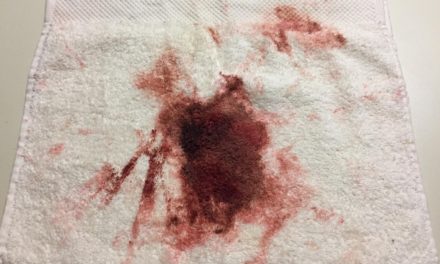
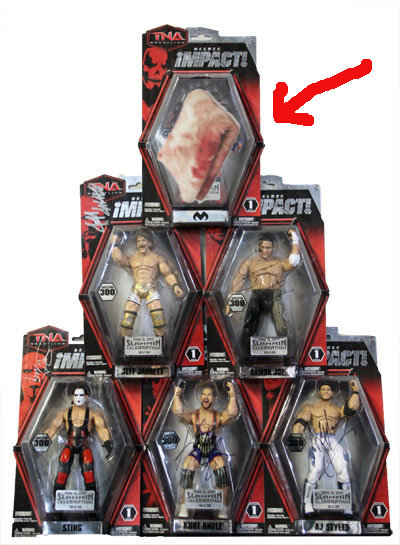
  • TNA Towel: 2, Believability: 0 (Apr): On a Monday night on TNA Impact, we got to see the TNA BloodyTowel ™ used again on a broadcast. Now I have to add another clause to the footnote of my answer of one of the most often asked question by casual or non-wrestling fans: Is the blood real?
  • TNA Waves the White Flag (May): After a few months of trying to compete head-to-head with Monday Night Raw, TNA retreats back to Thursdays.
  • TNA Should Add Bloody Towel to Roster (Jun): Since the towel has now gotten more air time than TNA president Dixie Carter, I figure TNA should just add the thing to their official roster.
  • The Highs and Lows of Monday Night Raw (Jun): The birth of NXT (high) and one of the most embarrassingly awful series of skits  with the actors from the new A-Team movie (low) all in the same episode of Raw.
  • Bigger Stronger Faster* (Jul): I rarely review movies here, but this was an exceptional documentary about the use, abuse, and propaganda of steroids. You may remember the filmmaker’s brother, Mike Bell, as an occasional jobber for the WWE, and for his death a few years after this documentary was filmed.
  • Final Match Rating Results (Jul): In July of 2009, I started collecting some data about the wrestling programming I was watching. What I was measuring this time was the number of matches per hour, and the quality of those matches as judged by a simple rating system. These are the final results after one year.
  • Final Wrestler Stats (Aug): I also have some Final Wrestler Stats. I used the same data to see who my top wrestlers were based on a simple match rating system.
  • Wait ‘Til Jumbo Gets Here (Sep): Quite often something seemingly unrelated triggers a memory that I decide to share on this site. Here’s a story from about 15 years ago…
  • My Wrestler Rankings vs. PWI 500 (Oct): I compared the list of wrestler rankings based on my data (see August above) to the PWI 500 for the year ending June 2010 to see if there was any correlation.
  • Line, Please (Nov): Comments on the Piper’s Pit segment and a supposedly leaked script from Monday Night Raw a year before, which implied that all of the wrestler promos were scripted by the “creative” dept.

WrestleZone is crediting PWInsider with reporting that the WWE Monday Night Raw guest host concept may be finished after about a year and a half of pulling in celebrities to boost exposure to the programming. I couldn’t find the original story, but I found a similar one on the Bleacher Report.
I don’t know if either story is based on some “insider” comments, or just their observation that the guest host section has been pulled from the WWE web site.

When Raw first started using this format, I wasn’t sure what to make of it (Raw Guest Hosts Not About Ratings?). After a little more investigation, it seemed like an ingenious idea (WWE + Talk Show = Raw), but not without its flaws. A shorter-term strategy that didn’t have a clear longer-term payoff as far as an increase in ratings.
Since then I have been more critical (Monday Night Boos, The Highs and Lows of Monday Night Raw, WWE: Don’t Call Us Wrestling).

I guess this has run its course, which seems like a good thing. Although I don’t see the product improving anytime soon as a result of this, and I’m a little nervous about what “great” idea they’ll come up with next.

I don’t spend too much time reading the wrestling sheets or sites. Partly because I actually want to be surprised when something happens on-air, and partly because there is just so much activity out there between “news” sites and blogs that it’s hard to separate the signal from the noise.

So it’s probably mostly luck that I stumbled across an opinion piece by Mark Madden on the WrestleZone site that touched on something I had meant to ask a year ago.

Mark says this,

Everyone is RAVING about the Piper’s Pit segment on Raw, citing [it] as evidence that old-school characters like Roddy Piper have it all over today’s crap performers.

That’s incorrect.

Oh, Piper was BRILLIANT. He added more value to the WWE title by talking about it than any champion of the past 10 years has done by wearing it. He led John Cena and Wade Barrett around like dogs on leashes, and to great effect.

and this,

But the reason that segment sparkled was because Roddy’s lines weren’t scripted. He [knew] what to advance, and he advanced it within the context of the Roddy Piper character, which he knows much better than anybody else who could ever write words for that character.

I beat this drum A LOT, but it’s a drum that needs beaten. WWE (and TNA) do things that are NOT a matter of opinion, NOT thinking outside the box, NOT a reasonable alternative. They’re just WRONG.

Scripting promos word-for-word is WRONG. It sounds like everyone’s speaking in the same voice.

I haven’t read any detailed reports about the level that the interviews and segments are scripted in WWE. I remember reading what was supposedly a “leaked” Monday Night Raw script, but I wasn’t convinced it was actually real. It looked realistic format-wise, but I have a hard time believing that anybody would be able to memorize a 10 minute promo the day of the event and not screw it up.

I am also guilty of fast-forwarding through just about all the interviews on every wrestling program, so I would only be giving an opinion on the small number that I have heard (Piper’s segment was one of them). But for the sake of discussion, lets assume that the “creative” team actually writes out the dialog for every interview.

Why would they do this? I can see where they have some bullet points or guidance to provide because they have the angles and feuds mapped out probably 6 to 9 months in advance. They know when all the Pay-Per-Views are scheduled and they are trying to set the road map for the company. But why would they actually write out the complete dialog for someone to memorize word-for-word?

If you’ve ever read anything about the Larry David show “Curb Your Enthusiasm” or any similar improv-style program, you know that they just have an outline and a general direction and the rest is improvised. That sounds like the perfect model for wrestling. It works as long as you’ve got guys that can talk, and wrestling has that.

The workers are going to have better ideas about the words they should choose and the personality of their character than some ex-sitcom hacks that the WWE hired. Maybe “creative” should worry less about the intricate details of the promos, and spend more time preventing  stupid decisions like making Vladymir Kozlov and Ezekiel Jackson babyfaces, keeping Kane employed, and having Microsoft Outlook be the WWE general manager.

Back in the beginning of August, I posted rankings of the top 15 wrestlers in the WWE and in TNA based on my own data on the quality of the matches over a one year period (Final Wrestler Stats)

Around the same time, Pro Wrestling Illustrated released their yearly PWI Top 500 wrestlers list. Regardless of what you think of their ranking system (I don’t remember how much effect reader ballots have on the rankings vs. PWI staff voting), I thought it would be interesting to match up my list with theirs to see how they compared.

Below are the same rankings I originally published, with the addition of the PWI top 500 ranking. Coincidently, the PWI rankings span the same months as my data collection (July through June).

WWE Top 15

Here are the Top 15 wrestlers under the WWE brands and their PWI 500 rankings for July 2009 through June 2010:

Name PWI 500 Ranking
1. John Morrison 27
2. Evan Bourne 63
2. Chris Jericho 21
2. Jack Swagger 5
5. Rey Mysterio 13
5. Christian 22
7. Dolph Ziggler 50
8. Kofi Kingston 26
8. Zack Ryder 117
10. CM Punk 3
11. Miz 12
12. Shelton Benjamin 76
12. John Cena 2
12. Jeff Hardy 20
12. Yoshi Tatsu 78

TNA Top 15

For TNA, there is only one program available that I was tracking (TNA Impact).

Here are the Top 15 wrestlers under the TNA brand and their PWI 500 rankings for July 2009 through June 2010:

Name PWI 500 Ranking
1. AJ Styles 1
2. Samoa Joe 31
3. Kurt Angle 9
4. Christopher Daniels 47
5. Chris Sabin 95
6. D’Angelo Dinero 87
6. Amazing Red 36
6. Doug Williams 45
6. Desmond Wolfe 28
10. Suicide/Kaz 92
10. Alex Shelley 88
10. Hamada not ranked
13. Matt Morgan 38
13. Hernandez 71
15. Sarita not ranked

Conclusion

Just what I expected… absolutely no correlation between my rankings and the PWI 500 (except for A.J. Styles in TNA).

You can see all the details about the rankings on the Wrestler Match Ratings page.

You can also look at the spreadsheet here– Google Docs: Wrestler Match Ratings Spreadsheet

From July 2009 through June of 2010, I collected some stats on the WWE Monday Night Raw, WWE Smackdown, and TNA wrestling products (and ECW until their shutdown on 2/19/2010). I was measuring the quality of the matches on each program by giving each one a “Thumb” rating. A great match gets one Thumb Up, an outstanding “match-of-the-year” candidate gets two Thumbs Up, and everything else gets zero (I was also giving Thumbs Down- more on that later).

When I recorded the Thumb Rating, I also happened to write down the names of the wrestlers that were involved in the matches. Since I had the data, I decided to total these up for each wrestler involved. All participants in the match got the same number of points.

You can read all the details and a bit of analysis on the Wrestler Match Ratings page, including a link to the spreadsheet so you can see the numbers for yourself.

I’m providing a quick summary below.

Top 15 in WWE and TNA

For the WWE, I used the combined data from the Raw, Smackdown, and ECW programming to calculate the rankings. I assigned one point per Thumb, so the scoring should be obvious.

WWE Top 15

Here are the Top 15 wrestlers under the WWE brands:

Name Total 1 Thumb Up 2 Thumbs Up
1. John Morrison 24 20 2
2. Evan Bourne 18 18 0
2. Chris Jericho 18 16 1
2. Jack Swagger 18 18 0
5. Rey Mysterio 17 13 2
5. Christian 17 15 1
7. Dolph Ziggler 15 15 0
8. Kofi Kingston 14 12 1
8. Zack Ryder 14 14 0
10. CM Punk 13 11 1
11. Miz 8 8 0
12. Shelton Benjamin 7 7 0
12. John Cena 7 7 0
12. Jeff Hardy 7 3 2
12. Yoshi Tatsu 7 7 0

TNA Top 15

For TNA, there is only one program available that I was tracking (TNA Impact).

Here are the Top 15 wrestlers under the TNA brand:

Name Total 1 Thumb Up 2 Thumbs Up
1. AJ Styles 22 12 5
2. Samoa Joe 13 11 1
3. Kurt Angle 12 6 3
4. Christopher Daniels 11 7 2
5. Chris Sabin 10 8 1
6. D’Angelo Dinero 9 9
6. Amazing Red 9 9
6. Doug Williams 9 9
6. Desmond Wolfe 9 5 2
10. Suicide/Kaz 8 8
10. Alex Shelley 8 8
10. Hamada 8 8
13. Matt Morgan 7 7
13. Hernandez 7 7
15. Sarita 6 6

Take a look at all the details on the Wrestler Match Ratings page.

You can also look at the spreadsheet here: Google Docs: Wrestler Match Ratings Spreadsheet

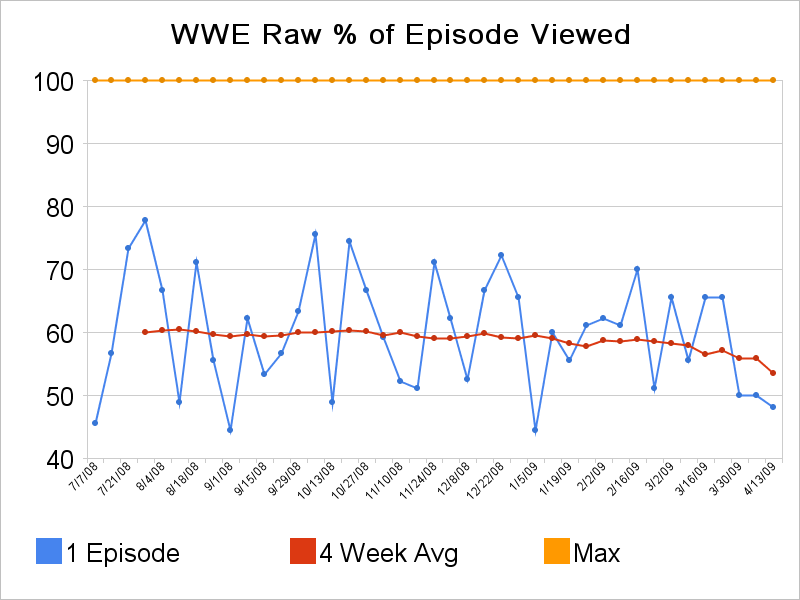
Back in July of 2008, I decided to keep track of my viewing time of WWE Monday Night Raw, ECW, TNA, and WWE Smackdown to see if I would be able to tell anything about the direction of the quality of the programming. This is assuming that if the quality (in my opinion) is better, I will watch more, and if the quality drops (again based on my tastes), I will watch less.

I tracked all four shows for a year before deciding to change things up and measure them differently (you can find the results of the that year-long experiment, including the charts and data, on the TV Viewership Stats page).

In July of 2009, I started collecting some different data about the same wrestling programming. What I was measuring this time was the number of matches per hour, and the quality of those matches as judged by a simple rating system.

The rating system I used was not one to five stars. It was closer to how I rate programming using my TiVo (Thumbs Up/2 Thumbs Up/Thumbs Down).

Since the WWE decided to shut down the ECW promotion, I stopped reporting on ECW and just did the other three.

The Final Results

After 52 weeks of collecting data from July 7th 2009 to July 9th 2010, here is a summary of the rating results. If you want to see more details, take a look at the TV Match Ratings page.

Thumbs Up/Thumbs Down Rating Totals

For each of the three brands, the thumb ratings have been totaled since I started collecting data the week of July 7th, 2009. Just to be clear, each “One Thumb Up” rating counts as one point, each “Two Thumbs Up” rating counts as two, and each “Thumb Down” rating counts as negative one (which subtracts from the total).

Here are the Thumbs Up/Thumbs Down ratings for the three programs:

Total Thumbs Up Ratings

Despite all of the negative press it gets, TNA pulled out ahead of Smackdown and way ahead of Raw in the quality of the matches (in my opinion). TNA would have been even farther ahead on positive ratings, except that they have had so many bad matches since Hogan and company showed up that it pulled their total down (remember a really bad match gets a Thumbs Down which reduces the total by one).

Avg Ratings Over Time

One other thing of note was the average ratings per match over time for each brand.

Avg Thumb Rating Per Match

The Raw guest host format has certainly affected the WWE programming. They are consistently at the bottom, even though it is supposedly the WWE’s “flagship” program. About 1 in 20 Raw matches is considered great.

If you take a look at the trend of TNA, you can see the damage Hulk Hogan and his cronies inflicted after the first of the year (about the midpoint of the charts). The average rating of each TNA match was climbing until Hogan took over. At its peak about 1 in 3 matches was great. It has been steadily falling since then, up until the last few weeks where it leveled out.

Smackdown has been fairly consistent over time, equaling TNA in the last couple of months. About 1 in 5 matches are considered great.

Take a look at all the stats and my “brilliant” conclusions over on the TV Match Ratings Page